Is your school’s student database a fortress or a sitting duck for cybercriminals?
Imagine arriving at your office in Lahore or Islamabad to find that your school’s entire fee record has been encrypted by ransomware, with a demand for millions of rupees in Bitcoin. This isn’t a plot from a tech thriller; in 2024 and 2025, ransomware accounted for 59% of cyberattacks on organizations globally, with educational institutions often being the softest targets. As Pakistan moves toward the full implementation of the Personal Data Protection Bill in 2026, failing to secure your campus management system is no longer just a technical oversight—it is a significant legal liability.
In this guide, you will learn the essential pillars of a secure ERP system and receive a comprehensive ERP security checklist to protect your institution’s reputation and your students’ privacy.
Why Is School Data Protection More Critical in 2026?
The educational landscape in Pakistan has shifted. We are no longer just protecting names and grades; we are handling sensitive digital footprints, including B-Form numbers, parent financial records, and even biometric attendance data. With the establishment of the National Commission for Personal Data Protection (NCPDP) under the 2026 legal framework, schools are now classified as data controllers with strict obligations to prevent misuse.
The “human element” remains the weakest link, involved in roughly 68% of data breaches. In many Pakistani schools, it is common to see a single admin password shared among five different clerks. This practice is a recipe for disaster. A secure ERP system must enforce individual accountability. If a student’s grade is changed or a fee record is deleted, your system must tell you exactly who did it and when.
Take the case of a prominent high school in Karachi that suffered a data leak in early 2025. An ex-employee still had access to the student information system because their account wasn’t deactivated upon resignation. The resulting breach of parent contact details led to a wave of phishing scams targeting the school’s community, severely damaging the institution’s hard-earned trust.
What Should Your ERP Security Checklist Include?
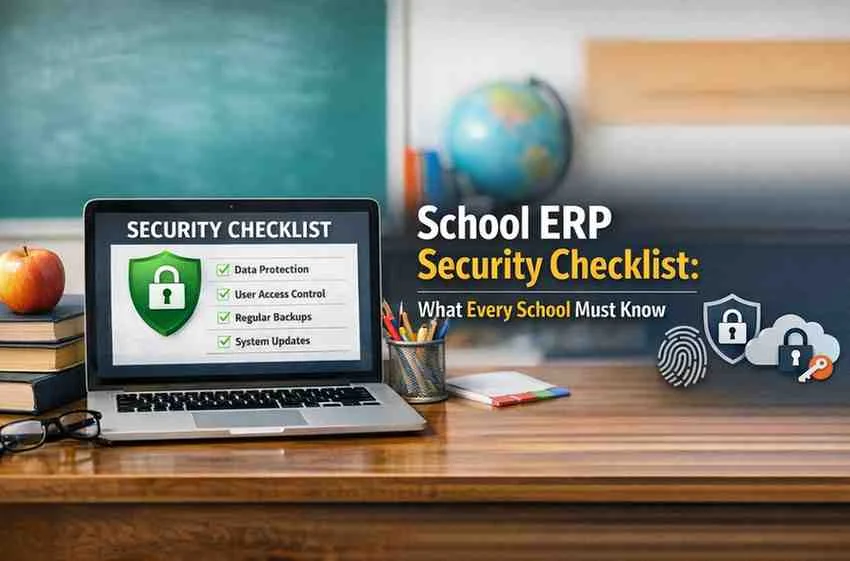
A robust ERP security checklist is your first line of defense against both external hackers and internal errors. You don’t need to be a computer scientist to implement these, but you must ensure your school software provider adheres to them.
1. Identity and Access Management
-
Multi-Factor Authentication (MFA): Require more than just a password. A simple SMS or app-based code can stop 99% of unauthorized login attempts.
-
Role-Based Access Control (RBAC): Does a sports coach need to see the school’s payroll? No. Ensure users only see the data required for their specific job.
-
Automatic Session Timeouts: If a registrar leaves their desk for tea, the system should automatically log them out after five minutes of inactivity.
2. Data Encryption Standards
-
Encryption at Rest: Ensure that if someone physically stole your server (or hacked the cloud storage), the data would be unreadable gibberish without the key.
-
Encryption in Transit: Your ERP must use HTTPS (the green padlock in the browser) to ensure data moving between the school and the server cannot be intercepted.
3. Backup and Disaster Recovery
-
Automated Daily Backups: Manual backups are often forgotten. Your system should back itself up every night to a geographically separate location.
-
The 3-2-1 Rule: Keep 3 copies of your data, on 2 different media types, with 1 copy stored off-site (ideally in a secure cloud environment like AWS or Azure).
How Does a Secure ERP System Prevent Financial Fraud?
Financial transparency is a major pain point for school owners in Pakistan. Without a secure ERP system, it is frighteningly easy for fee records to be manipulated. A “deleted” challan can mean lost revenue that goes unnoticed for months.
Advanced school automation prevents this through “Immutable Audit Logs.” In a secure system, no transaction is ever truly deleted; it is only reversed with a clear paper trail. This creates a psychological barrier for potential internal fraud. When staff members know that every click is recorded in a tamper-proof log, the temptation to manipulate records vanishes.
Consider a vocational college in Multan that implemented a secure ERP in 2024. Before the system, they struggled with “ghost” scholarship entries. After enforcing role-based approvals—where a principal had to digitally sign off on any fee waiver—they discovered a 15% discrepancy in their accounts. The system didn’t just protect data; it protected their bottom line.
What Are the Legal Risks of Ignoring School Data Protection?
Under the 2026 data laws in Pakistan, the “Right to Erasure” and “Right to Nominate” mean parents can legally demand to see how their child’s data is being used. If your school cannot provide a clear report on data usage or if you suffer a breach and fail to notify the authorities within the stipulated timeframe, the fines can be staggering.
Furthermore, sensitive personal data of children is now given extra protection. Practices such as tracking student behavior for targeted advertising or sharing student lists with third-party coaching centers without explicit consent are now strictly prohibited. A secure ERP system helps you manage these consents digitally, ensuring you stay on the right side of the law.
Actionable Takeaway for Principals:
Conduct a “Permissions Audit” this week. Ask your IT head for a list of everyone who has “Admin” or “Superuser” rights. You will likely find at least three people who don’t need that level of access. Strip those permissions back immediately to reduce your attack surface.
Talk to Our Experts Today
Instant support or book a free demo
Conclusion
Securing your school’s digital future is not a one-time task; it is an ongoing commitment to your students and their families. By implementing a rigorous ERP security checklist, you move from being reactive to being proactive. You transition from a state of “hoping we don’t get hacked” to “knowing we are protected.”
A secure ERP system is the backbone of a modern, trustworthy institution. It provides the peace of mind that allows you to focus on education rather than damage control. As we navigate the complexities of 2026 and beyond, let your school be the one that parents trust not just with their children’s minds, but with their digital identities.
Ready to secure your campus? Start by reviewing your current vendor’s security protocols against the checklist above. If they can’t answer the tough questions about encryption and audit logs, it might be time for a change.
FAQ Section
What is the most important item on an ERP security checklist?
In 2026, Role-Based Access Control (RBAC) combined with Multi-Factor Authentication (MFA) is the most critical. This ensures that even if a staff member’s password is stolen, the hacker cannot access sensitive financial or student data without the second verification step.
Does school data protection apply to small private schools?
Yes. Pakistan’s Personal Data Protection Bill applies to any entity that processes personal data. Regardless of your school’s size, you are legally responsible for the safety of the student information you collect and store.
Is cloud-based school automation more secure than on-premise servers?
Generally, yes. Professional cloud providers invest millions in security that a local school cannot afford. They offer automated updates, professional firewalls, and redundant backups that are far superior to a physical server sitting in a school’s IT room.
How often should we audit our ERP security?
You should conduct a basic internal permissions audit every quarter and a comprehensive security review with your school software provider at least once a year, preferably before the start of a new academic session.
What should I do if my school suffers a data breach?
Under new regulations, you must secure the system, identify the scope of the breach, and notify the National Commission for Personal Data Protection (NCPDP) and the affected parents. Having a secure ERP system with clear audit logs makes this process much faster and more accurate.
Can a secure ERP system help with board exam registrations?
Absolutely. By ensuring data accuracy and preventing unauthorized changes, a secure system makes the bulk export of student data for board registrations (like BISE or Cambridge) much safer and less prone to errors that could jeopardize a student’s academic year.