
Are you making critical school decisions based on guesswork instead of real data?
Many schools in Pakistan still rely on intuition rather than measurable insights. The result? Missed opportunities, declining performance, and inefficient operations. According to a 2025 UNESCO report, institutions using data-driven decision-making improved overall performance outcomes by up to 25%.
The problem isn’t a lack of data—it’s a lack of clarity on what to track.
This is where school KPIs come in. When combined with ERP analytics schools can finally turn raw data into actionable insights. In this guide, you’ll discover the most important school performance metrics you should track, how ERP systems simplify the process, and practical ways to use these KPIs to improve academic, operational, and financial outcomes.
What are school KPIs and why do they matter?
School KPIs (Key Performance Indicators) are measurable values that help you evaluate how effectively your institution is achieving its goals.
Without KPIs, you’re essentially flying blind.
Why KPIs are critical today
Modern education demands accountability, transparency, and performance tracking. Parents, administrators, and regulators all expect measurable results.
Common areas covered by school KPIs
- Academic performance
- Student attendance
- Financial health
- Teacher productivity
- Enrollment trends
Real-world example
A private school in Lahore started tracking key KPIs using their school ERP system. Within one year, they identified declining attendance patterns and implemented corrective measures, improving attendance rates by 18%.
Supporting data
According to McKinsey (2024), organizations that use KPIs effectively are 2.5 times more likely to outperform their peers.
Actionable takeaway
Start by defining clear goals:
- Improve student performance
- Increase enrollment
- Reduce operational inefficiencies
Then align your KPIs with these objectives.
Which academic school KPIs should you track using ERP analytics schools?
Academic performance is the core of any educational institution.
ERP analytics schools use help track student outcomes in real time, enabling timely interventions.
Key academic KPIs
- Student grades and pass rates
- Subject-wise performance
- Homework completion rates
- Exam performance trends
Why real-time tracking matters
Traditional reporting delays insights. By the time you notice a problem, it’s often too late.
Case study
A school in Karachi used ERP dashboards to monitor subject-wise performance. They discovered that math scores were consistently lower across grades. After introducing targeted teacher training, results improved significantly within one term.
Industry insight
EdTech Magazine (2025) reports that real-time academic tracking improves student outcomes by up to 20%.
Common mistake
Tracking too many metrics without focusing on actionable insights.
Actionable takeaway
Focus on:
- Weekly performance reviews
- Early identification of struggling students
- Data-driven teaching strategies
This ensures continuous academic improvement.
How can attendance and engagement KPIs improve school performance?
Attendance is more than just a number—it’s a leading indicator of student success.
Low attendance often signals deeper issues.
Important attendance KPIs
- Daily attendance rate
- Chronic absenteeism
- Class participation levels
- Student engagement metrics
Real-world example
A Multan-based school used ERP analytics to track attendance patterns. They found that absenteeism spiked on certain days. Adjusting schedules and engaging parents reduced absenteeism by 15%.
Why this matters
Students who attend regularly perform better academically and socially.
What I’ve learned
Attendance data is often underutilized. Yet, it’s one of the simplest ways to predict performance issues.
Actionable takeaway
Use your ERP system to:
- Set attendance alerts
- Notify parents instantly
- Analyze trends monthly
Improving attendance directly enhances overall school performance metrics.
What financial school KPIs should schools monitor?
Financial stability is essential for long-term success.
Without proper tracking, revenue leaks and inefficiencies can go unnoticed.
Key financial KPIs
- Fee collection rate
- Outstanding payments
- Revenue per student
- Operational costs
Case study
A school in Faisalabad tracked fee collection using ERP dashboards. They identified delays in payment reminders. After automating notifications, collection rates improved by 30%.
Supporting data
According to Deloitte (2025), organizations using financial analytics tools improve cash flow efficiency by up to 35%.
Common mistake
Relying on manual financial tracking, which increases errors.
Actionable takeaway
Implement:
- Automated fee reminders
- Real-time financial reporting
- Monthly revenue analysis
Strong financial KPIs ensure sustainable growth.
How do enrollment and retention KPIs drive growth?
Enrollment and retention are directly tied to your school’s success.
Tracking these KPIs helps you understand both growth and stability.
Key enrollment KPIs
- Number of new admissions
- Inquiry-to-enrollment conversion rate
- Dropout rate
- Student retention rate
Real-world example
A school in Islamabad used ERP analytics to track conversion rates. They discovered that slow follow-ups were causing lost admissions. After improving response time, enrollment increased by 25%.
Why retention matters
Keeping existing students is more cost-effective than acquiring new ones.
What I’ve learned
Most schools focus heavily on admissions but ignore retention metrics.
Actionable takeaway
Track:
- Monthly enrollment trends
- Reasons for student withdrawals
- Parent satisfaction levels
These insights help you build long-term growth strategies.
How can teacher performance KPIs improve overall outcomes?
Teachers are the backbone of your institution.
Tracking their performance ensures consistent quality in education.
Key teacher KPIs
- Lesson completion rates
- Student performance improvement
- Attendance and punctuality
- Feedback from students and parents
Case study
A Lahore-based school introduced teacher performance dashboards through their ERP system. They identified gaps in lesson planning and provided targeted training. Within months, student outcomes improved noticeably.
Industry insight
According to a 2024 OECD study, teacher effectiveness is one of the strongest predictors of student success.
Common mistake
Evaluating teachers only once a year instead of continuous monitoring.
Actionable takeaway
Use ERP tools to:
- Monitor performance regularly
- Provide constructive feedback
- Offer professional development opportunities
Better teachers lead to better results.
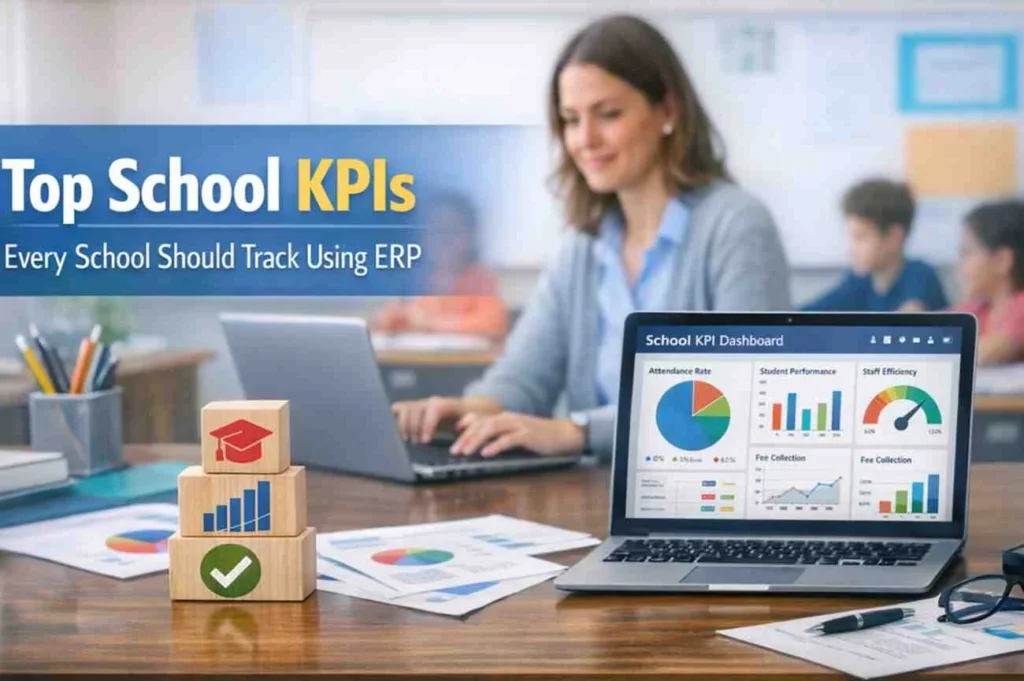
How do ERP dashboards make KPI tracking easier?
Tracking KPIs manually is time-consuming and error-prone.
ERP dashboards simplify the process by centralizing all data in one place.
Benefits of ERP dashboards
- Real-time insights
- Visual data representation
- Automated reporting
- Easy access to key metrics
Example
A school network in Karachi used ERP dashboards to monitor multiple branches. This allowed leadership to make quick, informed decisions without waiting for reports.
What makes dashboards powerful
They turn complex data into simple visuals that anyone can understand.
Actionable takeaway
Set up dashboards for:
- Academic performance
- Financial tracking
- Attendance monitoring
This ensures quick and effective decision-making.
Conclusion
In today’s data-driven world, relying on intuition is no longer enough.
Tracking the right school KPIs using ERP analytics schools depend on can transform your institution. From academic performance and attendance to financial health and teacher effectiveness, every metric provides valuable insights.
The key is not just collecting data—but using it to drive action.
Start small. Focus on a few critical KPIs, monitor them consistently, and expand as your system matures.
Your next step? Review your current reporting methods and identify gaps. Then implement an ERP system that provides real-time visibility into your school performance metrics.
Because when you measure what matters, you improve what matters.
FAQ Section
What are school KPIs in education?
School KPIs are measurable indicators used to track academic, financial, and operational performance in educational institutions.
How does ERP analytics help schools track KPIs?
ERP analytics schools use provide real-time data, automated reports, and dashboards to monitor performance effectively.
Which school KPIs are most important?
Academic performance, attendance rates, fee collection, enrollment trends, and teacher performance are key KPIs.
Can small schools use KPI tracking effectively?
Yes, even small schools can benefit from tracking basic KPIs using affordable ERP systems.
How often should schools review KPIs?
Ideally, KPIs should be reviewed weekly or monthly depending on the metric.
Do KPIs improve student outcomes?
Yes, data-driven decisions based on KPIs help identify issues early and improve learning outcomes.
What is the role of dashboards in KPI tracking?
Dashboards provide visual insights, making it easier to understand and act on data quickly.