
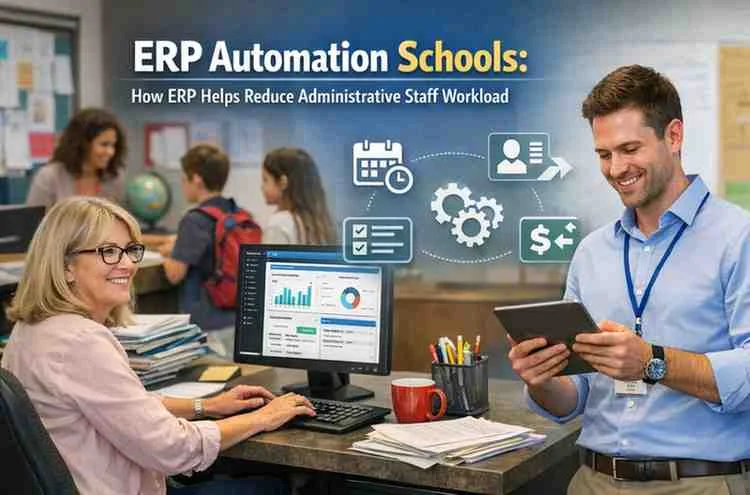
Is your school administration drowning in a sea of manual data entry while your academic standards suffer?
In many Pakistani private and public institutions, the administrative office often looks like a relic of the past, filled with dusty ledgers and overworked staff manually calculating monthly fees. I recently spoke with a principal in Lahore who realized her registrar was spending forty hours a month just reconciling bank challans against student records. This is not just a waste of human potential; it is a systemic bottleneck that prevents institutional growth. By shifting toward ERP automation schools, leadership can reclaim these lost hours and redirect focus toward what actually matters: student outcomes.
In this comprehensive guide, you will learn how modernizing your campus through school automation can eliminate repetitive tasks, improve data accuracy, and significantly lower the stress levels of your administrative team.
Why Is Admin Workload Reduction Crucial for Modern Pakistani Schools?
The educational landscape in Pakistan is becoming increasingly competitive. With the rise of international standards and more rigorous regulatory requirements from bodies like the Federal Board or various provincial departments, the volume of paperwork has exploded. When staff members are bogged down by manual record-keeping, they lack the time to provide quality service to parents or support to teachers.
Research indicates that administrative staff in traditional school settings spend up to 60% of their time on repetitive data entry. A study by the Sustainable Development Policy Institute (SDPI) on digital readiness suggests that educational institutions utilizing integrated systems see a 40% increase in administrative efficiency within the first year. This is the essence of admin workload reduction: it is not about replacing people, but about removing the “busy work” that leads to burnout and human error.
Take the case of a mid-sized school system in Karachi. Before adopting ERP automation schools strategies, their month-end closing took ten days. After implementing an automated module for fee collection and payroll, that window shrunk to forty-eight hours. The staff didn’t lose their jobs; they shifted to roles focused on parent engagement and admissions strategy.
How Does ERP Automation Schools Technology Streamline Fee Management?
Fee collection is notoriously the most labor-intensive part of school administration in Pakistan. Between managing scholarships, sibling discounts, late fines, and transport charges, the permutations are endless. Manually generating thousands of challans is a recipe for disaster.
School automation solves this by creating a centralized financial engine. When a student is enrolled, the system automatically calculates their specific fee structure based on pre-set parameters. Integration with local banking APIs allows for real-time reconciliation. When a parent pays via a mobile app or at a bank branch, the student’s record is updated instantly without a clerk needing to touch a keyboard.
Actionable Tip for Implementation:
Start by mapping your current discount logic. Most ERP failures happen because the software cannot handle the complexity of local “hidden” discounts. Ensure your chosen system allows for multi-layered fee rules that can be applied in bulk.
Can School Automation Improve Communication Without Increasing Workload?
One of the biggest drains on administrative time is the constant barrage of phone calls from parents asking about attendance, exam schedules, or homework. In a traditional setup, a staff member has to find the physical file, check the register, and then call the parent back.
By utilizing ERP automation schools platforms, communication becomes proactive rather than reactive. Automated SMS triggers and mobile app notifications can alert parents the moment a student is marked absent or when a result is published. This self-service model empowers parents to find information themselves, which leads to a dramatic drop in inbound inquiries.
A prominent school group in Islamabad reported a 70% decrease in routine inquiry calls after launching a dedicated parent portal. This allowed their front-desk staff to focus on high-value tasks like managing new admissions and organizing school events.
What Are the Common Mistakes When Moving to ERP Automation Schools?
The transition to a digital campus is not without its hurdles. The most common mistake I see is “garbage in, garbage out.” If your initial data migration is flawed, the automation will simply accelerate your errors.
Another pitfall is choosing a global ERP that doesn’t understand the local context of Pakistan, such as the specific tax requirements or the traditional “challan” system. It is vital to choose a partner that offers local support and understands the nuances of the regional education boards.
To avoid these issues, follow these steps:
-
Conduct a thorough audit of your existing data before migration.
-
Run the ERP in parallel with your manual system for at least one quarter.
-
Appoint a “Power User” in each department to champion the change.
Is the Investment in School Automation Justifiable for Smaller Institutions?
A common misconception is that ERP systems are only for elite, high-fee schools. However, the ROI for smaller institutions is often even higher because they have fewer staff members to spare. When one person is doing the job of three, automation is a survival tool, not a luxury.
Consider the cost of a single administrative error in a manual system—a missed fee payment or a lost registration form for a board exam. These mistakes carry heavy financial and reputational costs. Modern cloud-based ERPs offer subscription models that scale with your student population, making the entry barrier much lower than it was a decade ago.
Implementation Checklist:
-
Identify the three most time-consuming manual processes.
-
Evaluate ERP vendors based on their local support presence in Pakistan.
-
Schedule a demo specifically for the fee and examination modules.
-
Set a timeline for staff training and data migration.
Talk to Our Experts Today
Instant support or book a free demo
Conclusion
Embracing ERP automation schools is no longer a futuristic goal; it is a baseline requirement for any institution that wishes to remain relevant in Pakistan’s evolving educational sector. By prioritizing admin workload reduction, you are not just buying software; you are investing in the mental well-being of your staff and the professional image of your school.
The transition to school automation allows your team to step away from the calculator and the filing cabinet, giving them the freedom to build a better learning environment. Whether you are managing a single branch or a massive network, the path to efficiency starts with a single digital step.
Are you ready to stop managing paperwork and start managing growth? Begin by auditing your most tedious manual tasks today and see how much time your institution can save.
FAQ Section
How long does it take to see an admin workload reduction?
Most schools notice a significant change within the first three months. While the initial data entry and training phase requires effort, the time saved on fee reconciliation and report generation provides immediate relief to the staff.
Is ERP automation schools software difficult for non-technical staff to use?
Modern systems are designed with user-friendly interfaces similar to social media or banking apps. With proper training sessions, even staff with basic computer literacy can master the essential functions of school automation within a few weeks.
Does school automation require expensive hardware?
Not necessarily. Most contemporary ERPs are cloud-based, meaning you only need a stable internet connection and standard computers or tablets. This eliminates the need for expensive on-site servers and dedicated IT maintenance teams.
Can these systems handle the specific Pakistani grading boards?
Yes, reputable ERP automation schools providers in Pakistan customize their examination modules to align with the requirements of various Boards of Intermediate and Secondary Education (BISE) and Cambridge International (O/A Levels).
How does this help with student admissions?
Automation streamlines the entire funnel, from online inquiries to digital entrance tests and automated merit list generation. This reduces the admission office’s workload during the peak season and provides a professional experience for prospective parents.
What about data security in ERP automation schools?
Security is a top priority. Leading providers use encrypted cloud storage and role-based access control, ensuring that sensitive student and financial data is only visible to authorized personnel, which is often much more secure than physical paper files.