Are you tired of forcing your unique school processes into a rigid software box, or are you terrified of the skyrocketing costs of building a system from scratch?
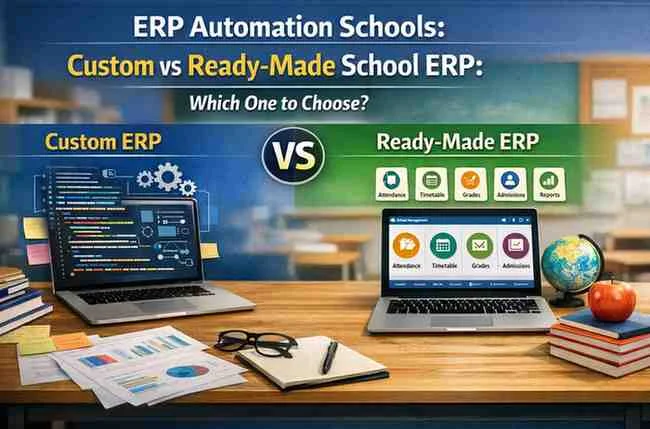
In the competitive landscape of the Pakistani education sector, I have seen many prestigious institutions in Lahore and Islamabad lose months of productivity because they chose the wrong digital foundation. A recent industry report suggests that nearly 70% of custom ERP software projects in the education sector exceed their original budget by at least 40%. Whether you are a small Montessori or a multi-city college network, the debate between Custom vs Ready-Made School ERP is more than a technical choice; it is a long-term financial commitment.
In this guide, you will learn the critical differences between these two paths, how each impacts your admin workload reduction, and exactly how to identify which model fits your school’s unique DNA in 2026.
What Is the Real Cost of Building a Custom ERP vs Ready-Made School ERP?
When school owners hear the word custom, they often think of a tailor-made suit that fits perfectly. While that sounds appealing, the financial reality in Pakistan is often closer to building a house from the ground up without a fixed blueprint. A custom-built system requires hiring developers, conducting endless testing cycles, and managing ongoing security updates. This often results in a massive upfront investment that can take years to break even.
On the other hand, ready-made school automation solutions operate on a SaaS (Software as a Service) model. You pay for what you use, and the development costs are shared across thousands of other institutions. According to data from the Pakistan Software Houses Association (P@SHA), maintenance for custom-built local systems often costs 20% of the original development price annually. Ready-made systems include these updates in their monthly or yearly subscription, providing a predictable budget for board members who hate surprises.
Consider a case study from a private school network in Faisalabad. They initially spent three million PKR on a custom solution that became obsolete within two years when the provincial education board changed the examination reporting standards. They eventually switched to a ready-made ERP that updated its modules automatically to meet the new standards within a week, at zero extra cost to the school.
How Does ERP Customization Impact Your Staff Training and Adoption?
One of the biggest hidden hurdles in school management is getting the staff to actually use the software. If a system is too complex, your admin workload reduction goals will vanish as employees revert to their old paper registers. In the Custom vs Ready-Made School ERP debate, usability is where ready-made systems usually win. Because these products are used by thousands of teachers and clerks, their interfaces have been refined based on massive amounts of user feedback.
However, some schools have highly specific workflows—such as unique scholarship structures or complex sibling discount logic common in Pakistani family-run schools—that standard software might struggle to handle. This is where ERP customization within a ready-made system becomes the middle ground. Most modern vendors now offer modular flexibility, allowing you to toggle features on or off without writing a single line of code.
What I have learned from observing deployments across Sindh and Punjab is that “custom” often leads to “complicated.” A high-end school in Karachi once built a system so specific to their old registrar’s habits that when he retired, nobody else knew how to operate the backend. Ready-made systems prevent this “person-dependency” by following industry-standard workflows that any new hire can learn in a few hours.
Does Your School Need the Flexibility of a Custom-Built System?
If your institution operates on a traditional model, a ready-made system is almost always the smarter choice. But what if you are running an unconventional IB school or a technical vocational center with non-standard grading? In these rare cases, the Custom vs Ready-Made School ERP system choice leans toward custom. You might need specific integration with proprietary hardware or a very niche student tracking methodology that doesn’t exist in the mass market.
Before you commit to a custom build, ask yourself: Is our process actually better, or just different? Often, schools insist on custom software to mimic an inefficient manual process they have used for thirty years. True school automation should be an opportunity to audit and improve your workflows, not just digitize bad habits.
An actionable takeaway: List your top ten administrative pain points. If a ready-made ERP can solve eight of them out of the box, it is far more cost-effective to adapt your two minor processes to the software than to pay for a custom build to satisfy all ten. Remember, every line of custom code you own is a line of code you have to pay to fix when it breaks.
How Does Each Option Handle Data Security and Compliance in Pakistan?
With the increasing focus on data privacy laws in Pakistan, such as the Personal Data Protection Bill, how you store student records is now a legal concern. Ready-made ERP providers invest millions in security certifications, encrypted cloud servers, and redundant backups. They are prepared for cyber threats because their entire business depends on it.
When you choose a custom-built route, the responsibility of security falls entirely on your shoulders—or the shoulders of the small local dev shop you hired. If their server isn’t patched or their code has a vulnerability, your student data is at risk. For most Pakistani school principals, managing a server room is not their core competency.
A real-world example of this risk occurred recently when a local college’s custom database was corrupted during a routine power surge because they lacked professional-grade cloud redundancy. They lost three years of academic transcripts. Conversely, schools using cloud-based school automation were unaffected, as their data was hosted in world-class data centers with 99.9% uptime guarantees.
Talk to Our Experts Today
Instant support or book a free demo
Conclusion: Making the Final Decision for Your Institution
Choosing between Custom vs Ready-Made School ERP is ultimately a choice between being a software manager or an education leader. For 95% of schools in Pakistan, the ready-made route offers the fastest path to admin workload reduction and institutional growth. It provides a stable, secure, and affordable platform that evolves with the industry.
Custom systems should be reserved for organizations with massive budgets and truly unique pedagogical models that cannot be served by existing tech. For everyone else, the goal should be to find a reputable ready-made provider that offers enough ERP customization to feel personal without the headache of building from scratch.
Your next step should be to request demos from at least three ready-made ERP vendors. Bring your most “difficult” administrative staff to the demo and see if they find the interface intuitive. The best software isn’t the one with the most features; it’s the one your staff will actually use every day.
FAQ Section
Is a ready-made ERP less flexible than a custom one?
While you cannot change the core architecture, most ready-made systems offer significant ERP customization. You can usually modify fee structures, report card templates, and user permissions to fit your school’s specific needs without the high cost of custom coding.
How does the implementation time differ?
Ready-made school automation can be deployed in as little as 48 hours since the infrastructure is already built. A Custom vs Ready-Made School ERP comparison shows that custom builds typically take 6 to 12 months before they are fully functional.
Which option is better for a school on a tight budget?
Ready-made systems are significantly cheaper upfront. They usually involve a small setup fee and a manageable monthly subscription. Custom systems require a large capital expenditure that most small to mid-sized schools in Pakistan find difficult to sustain.
Can I migrate my data from an old custom erp software to a ready-made one?
Yes, most professional ERP providers offer data migration services. They can take your existing Excel sheets or legacy database files and map them into the new system, ensuring your historical student records are preserved during the transition.
Does school automation replace administrative staff?
No, it empowers them. The goal of admin workload reduction is to eliminate the 10 hours a week spent on manual calculations so that staff can focus on student welfare, parent communication, and improving the quality of the institution.
What happens if the ready-made ERP company closes down?
This is a valid concern. To mitigate this, choose established vendors with a large client base in Pakistan and ensure your contract allows you to export your data in a standard format (like CSV or SQL) at any time.