
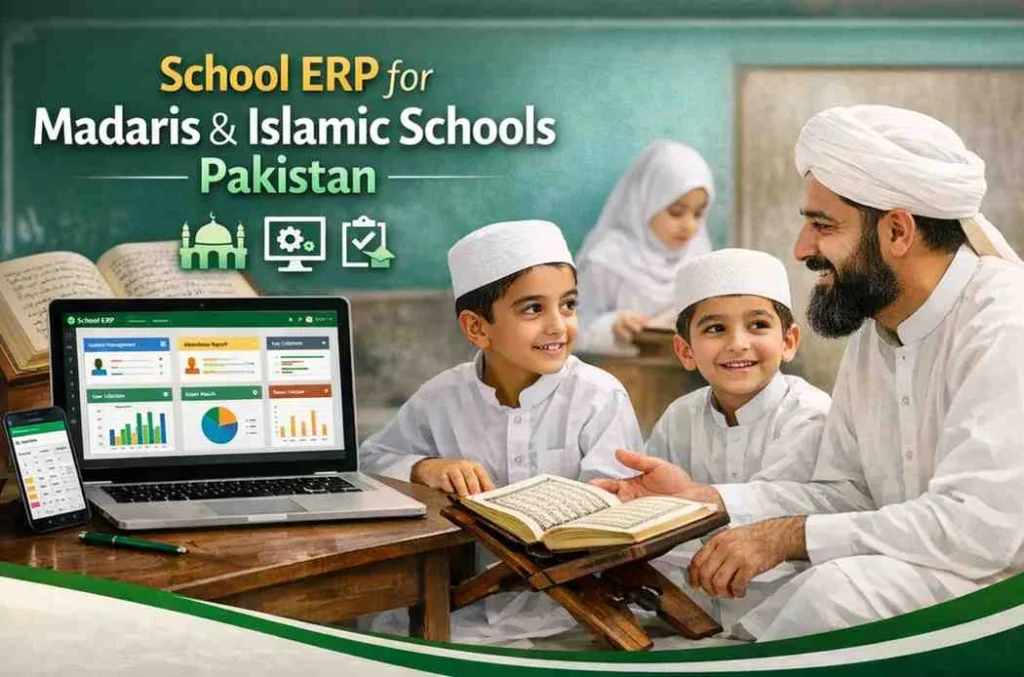
Are you struggling to manage student records, fees, and daily operations in your madrasa without errors or delays?
Many madaris and Islamic schools across Pakistan still rely on manual registers and disconnected processes. While this traditional system has worked for decades, it often leads to misplaced records, inefficient communication, and limited growth. According to a 2024 report by Pakistan EdTech Network, over 55% of religious institutions are now exploring digital solutions to improve administration.
This is where School ERP for Madaris becomes a powerful solution. It allows you to manage admissions, attendance, academics, and finances—all from one system. In this guide, you’ll learn how madrasa management software works, why it’s essential today, and how you can implement it effectively—even with limited resources.
What is School ERP for Madaris and how does it work?
School ERP for Madaris is a centralized digital system designed specifically to manage the operations of Islamic schools and religious institutions.
Instead of handling everything manually, you get a single platform that organizes student data, teacher records, class schedules, and finances.
How it works in practice
- All student records are stored digitally
- Attendance is tracked daily with minimal effort
- Fee collection and expenses are recorded automatically
- Reports can be generated instantly
Why this matters
A traditional madrasa system often depends heavily on individuals. If a staff member leaves, important knowledge or records can be lost. ERP eliminates that risk.
Real-world example
A madrasa in Karachi transitioned from paper-based records to a digital system. Within three months, they reduced administrative workload by 40% and eliminated duplicate records completely.
Actionable takeaway
Start by digitizing your student records. Even a basic database is the first step toward full ERP implementation.
Why do Islamic schools in Pakistan need madrasa management software today?
The education landscape is changing rapidly—even for religious institutions.
Parents now expect transparency, quick updates, and organized systems, whether it’s a traditional school or a madrasa.
Key challenges madaris face
- Manual errors in student data
- Difficulty tracking attendance and performance
- Inefficient fee management
- Lack of communication with parents
Supporting data
According to UNESCO (2025), institutions adopting digital education tools improved administrative efficiency by up to 30%.
Case study
An Islamic school in Lahore introduced madrasa management software to handle admissions and communication. Within one academic year, parent satisfaction improved significantly, and administrative delays dropped by 50%.
What I’ve learned
Many madrasa administrators hesitate to adopt technology, thinking it’s complex or expensive. In reality, modern ERP systems are designed to be simple and scalable.
Actionable takeaway
Focus on one problem at a time:
- Start with attendance tracking
- Then move to fee management
- Gradually expand to full ERP
How does Islamic school ERP improve student management and tracking?
Managing hundreds of students manually is not just difficult—it’s risky.
Islamic school ERP systems bring structure and visibility to student management.
Key features
- Student profiles with complete history
- Attendance tracking
- Academic progress monitoring
- Behavior and discipline records
Mini case study
A madrasa in Multan implemented a student tracking module. Teachers could instantly access student records and performance data. This improved academic monitoring and helped identify struggling students early.
Why this is powerful
You’re not just storing data—you’re using it to make better decisions.
Common mistake
Some institutions collect data but don’t analyze it. Without insights, data has little value.
Actionable takeaway
Use your ERP system to:
- Track attendance trends
- Monitor academic progress
- Identify students needing extra support
Better student tracking leads to better outcomes.
How can a madrasa system simplify fee and financial management?
Financial transparency is critical for trust and sustainability.
A madrasa system automates fee collection and expense tracking, reducing errors and improving accountability.
What changes with ERP
- Automated fee reminders
- Digital fee records
- Expense tracking
- Financial reports
Real-world example
A madrasa in Faisalabad implemented digital fee tracking and reduced late payments by 35% within six months.
Why it matters
Manual systems often lead to missed payments or incorrect records, which directly impact your financial stability.
Actionable takeaway
Implement:
- Monthly automated fee reminders
- Digital receipts
- Clear financial reporting
These small changes can make a significant difference.
How does School ERP for Madaris improve communication with parents?
Communication is often overlooked in madaris—but it’s essential.
Parents want to stay informed about their child’s progress, attendance, and activities.
ERP communication tools
- SMS alerts for attendance and fees
- Parent portals
- Event notifications
- Direct messaging
Case study
An Islamic school in Islamabad introduced SMS-based updates through ERP. Parents received daily attendance notifications, which significantly increased trust and engagement.
Why this matters
Strong communication builds stronger relationships—and that leads to better retention and reputation.
Actionable takeaway
Start with simple communication tools:
- Send weekly updates to parents
- Notify them of absences
- Share academic progress regularly
Can madrasa management software support growth and modernization?
Yes—and this is where ERP becomes a long-term investment.
Modern madaris are expanding their offerings, including formal education alongside religious studies. ERP systems support this transition.
Growth opportunities
- Managing multiple campuses
- Introducing online classes
- Expanding student intake
- Improving operational efficiency
Example
A large madrasa network in Punjab used ERP to standardize operations across branches. This allowed them to scale without losing control over quality or administration.
Industry trend
Post-2024, hybrid education models are becoming more common—even in religious institutions.
What I’ve learned
Growth without systems leads to chaos. ERP provides the structure needed to scale effectively.
Actionable takeaway
If you plan to expand:
- Standardize your processes
- Use ERP for centralized control
- Monitor performance across branches
Conclusion
Managing a madrasa today requires more than dedication—it requires systems that support efficiency, transparency, and growth.
School ERP for Madaris offers a practical solution to modern challenges. From student management to financial tracking and communication, it simplifies every aspect of administration.
You don’t need to overhaul everything overnight. Start small—digitize records, automate attendance, and improve communication. Then gradually expand into full madrasa management software.
Your next step? Evaluate your current processes and identify gaps. Explore ERP solutions tailored for Islamic schools in Pakistan and begin your digital transformation journey.
The sooner you act, the easier it becomes to manage, grow, and sustain your institution.
FAQ Section
What is School ERP for Madaris?
It is a digital system designed to manage student records, attendance, fees, and operations in madaris and Islamic schools efficiently.
Is madrasa management software expensive?
Not necessarily. Many affordable solutions are available in Pakistan, and you can start with basic features before scaling.
Can small madaris use ERP systems?
Yes, even small institutions benefit from improved organization and reduced manual work through ERP systems.
How does Islamic school ERP improve efficiency?
It automates repetitive tasks, centralizes data, and provides real-time insights for better decision-making.
Does ERP help with fee collection?
Yes, automated reminders and digital records significantly improve fee collection and reduce delays.
How long does implementation take?
Basic ERP systems can be implemented within a few weeks, depending on the institution’s size.
Is training required for staff?
Minimal training is needed, as most modern ERP systems are user-friendly and designed for non-technical users.