
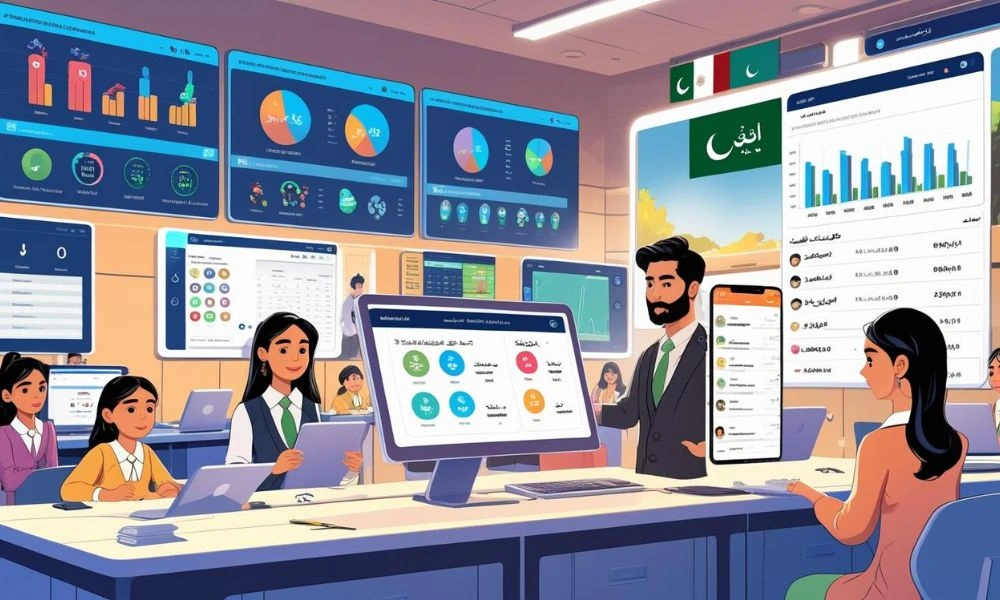
Are you finding it harder every year to increase admissions and maintain steady income for your school?
You’re not alone. Many schools across Pakistan struggle with rising operational costs, delayed fee collections, and inconsistent enrollment numbers. A 2024 report by HolonIQ reveals that institutions adopting digital systems saw up to 25% improvement in operational efficiency and revenue performance.
The reality is simple: traditional systems can’t keep up anymore. If you want sustainable School Revenue growth, you need smarter systems, not just harder work. That’s where ERP comes in.
In this guide, you’ll discover exactly how ERP benefits schools by improving admissions, reducing revenue leakage, optimizing operations, and unlocking new income streams. More importantly, you’ll get practical strategies you can apply immediately—even with limited resources.
How does ERP directly impact School Revenue growth?
School revenue isn’t just about collecting fees—it’s about maximizing every opportunity from inquiry to alumni.
An ERP system connects all departments, ensuring no revenue opportunity is missed.
Where revenue is typically lost
- Untracked admission inquiries
- Delayed fee collections
- Manual errors in billing
- Poor retention of students
How ERP fixes this
ERP centralizes your data and automates key workflows. You can track leads, monitor fee payments, and identify drop-offs in real time.
Real-world example
A mid-sized private school in Lahore implemented a school ERP system and discovered that 18% of admission inquiries were never followed up. After automating follow-ups, they increased enrollments by 22% in one academic year.
Actionable takeaway
Audit your current revenue leaks:
- Track how many inquiries convert to admissions
- Identify delays in fee collection
- Analyze student dropout rates
Fixing just one of these can significantly improve School Revenue growth.
Can ERP increase student enrollment and admissions?
Absolutely—and this is one of the fastest ways to grow revenue.
Admissions are your primary revenue engine, and ERP helps you optimize every stage of the funnel.
How ERP boosts enrollment
- Automated lead tracking
- Instant communication with parents
- Online application portals
- Data-driven admission decisions
Case study
A Karachi-based school introduced an online admission system integrated with ERP. They reduced response time from 48 hours to under 6 hours. The result? A 30% increase in admission conversions within one cycle.
What most schools get wrong
They focus only on marketing but ignore follow-up systems. Leads go cold quickly if not managed properly.
Actionable takeaway
Use ERP to:
- Respond to inquiries within 24 hours
- Track conversion rates weekly
- Automate reminders for incomplete applications
Better admissions management directly translates into School Revenue growth.
How does ERP improve fee collection and financial management?
Delayed payments and financial mismanagement can quietly drain your revenue.
ERP systems bring transparency and automation into financial operations, ensuring consistent cash flow.
Key features that drive revenue
- Automated fee reminders via SMS/email
- Online payment integrations
- Real-time financial dashboards
- Accurate billing and reporting
Supporting data
According to EdTech Magazine (2024), schools using automated fee systems reduced late payments by up to 35%.
Example
A school in Faisalabad switched to ERP-based fee management and saw immediate results. Late payments dropped significantly, and administrative workload decreased by 40%.
Common mistake
Some schools implement ERP but don’t activate online payments. That limits the system’s potential.
Actionable takeaway
Set up:
- Automated reminders before due dates
- Digital payment options
- Monthly financial reports
Consistency in collections is one of the most reliable drivers of School Revenue growth.
How can ERP reduce operational costs and increase profitability?
Revenue growth isn’t just about earning more—it’s also about spending smarter.
ERP benefits schools by reducing unnecessary operational costs.
Where costs are reduced
- Paper-based processes
- Manual administrative work
- Duplicate data entry
- Staffing inefficiencies
Real-world example
A school network in Islamabad reduced administrative costs by 20% after digitizing attendance, reporting, and communication through ERP.
Industry insight
A 2025 UNESCO report highlights that digital transformation in education can reduce administrative overhead by up to 30%.
What I’ve learned
Many school owners focus only on top-line revenue. But improving margins through cost efficiency is often easier and faster.
Actionable takeaway
Start with high-impact areas:
- Digitize attendance and reporting
- Automate repetitive tasks
- Reduce dependency on paper
Every rupee saved contributes directly to profitability.
How does ERP improve student retention and lifetime value?
Retention is one of the most overlooked drivers of School Revenue growth.
Acquiring new students is expensive. Keeping existing ones is far more profitable.
How ERP helps retain students
- Performance tracking and early intervention
- Transparent communication with parents
- Personalized student support
- Engagement through portals and updates
Case study
A private school in Multan used ERP analytics to identify students with declining performance. Early intervention reduced dropout rates by 15% within a year.
Why retention matters
Losing a student doesn’t just mean losing one year’s fee—it affects long-term revenue.
Actionable takeaway
Use ERP dashboards to:
- Monitor attendance and performance trends
- Identify at-risk students
- Engage parents proactively
Retention directly impacts your long-term revenue stability.
Can ERP create new revenue streams for schools?
Yes—and this is where many schools miss out.
ERP systems don’t just optimize existing processes—they open doors to new income opportunities.
Potential revenue streams
- Online courses and digital classes
- Paid extracurricular programs
- Alumni donations and events
- Certification programs
Example
A school in Lahore used its ERP platform to launch weekend online classes. Within six months, it created an additional revenue stream contributing 10% to total income.
Trend insight
Post-2024, hybrid learning models are becoming standard. Schools that adapt early gain a competitive edge.
Actionable takeaway
Leverage your ERP system to:
- Offer online learning modules
- Promote extracurricular activities
- Build alumni engagement programs
Diversification strengthens your overall financial health.
Talk to Our Experts Today
Instant support or book a free demo
Conclusion
If you’re serious about sustainable growth, relying on outdated systems is no longer an option.
ERP transforms how schools operate—from admissions and fee collection to retention and expansion. It eliminates inefficiencies, improves decision-making, and unlocks new revenue opportunities.
The path to School Revenue growth is clear: optimize your processes, automate your workflows, and use data to guide every decision.
Start small if needed. Focus on admissions and fee management first, then expand into analytics and engagement modules.
Your next step? Evaluate your current systems, identify gaps, and explore ERP solutions tailored for schools in Pakistan. The sooner you act, the faster you’ll see measurable financial results.
FAQ Section
How does ERP contribute to School Revenue growth?
ERP improves efficiency, increases admissions, ensures timely fee collection, and reduces operational costs—all contributing directly to revenue growth.
Is ERP suitable for small schools in Pakistan?
Yes, many affordable ERP solutions are designed for small to mid-sized schools. You can start with basic modules and scale as needed.
What are the main ERP benefits schools experience?
ERP benefits schools by automating processes, improving communication, enhancing financial management, and providing real-time data insights.
Can ERP reduce fee collection delays?
Absolutely. Automated reminders and online payments significantly reduce delays and improve cash flow.
How long does ERP implementation take?
Basic ERP systems can be implemented within 2–6 weeks, depending on school size and requirements.
Does ERP help increase student enrollment?
Yes, by streamlining admissions and improving response times, ERP systems can significantly boost enrollment rates.
What is the ROI of implementing a school ERP system?
Most schools see ROI within 6–12 months through increased admissions, reduced costs, and improved fee collection efficiency.