What would it mean for your school if the software managing your fee records, attendance, and student data updated itself overnight — with no IT team, no downtime, and no invoice for a technician?
That’s not a hypothetical. It’s exactly what SaaS-based ERP systems deliver, and it’s one of the clearest reasons private schools across Pakistan are migrating away from desktop software and locally hosted systems at an accelerating rate.
The global education ERP market is projected to grow from USD 16.1 billion in 2023 to USD 66.3 billion by 2033, at a compound annual growth rate of 15.2 percent (Market Research, 2024). The shift is happening everywhere — but in Pakistan, it carries additional urgency. Pakistan’s Cloud First Policy, introduced in 2022 by the Ministry of Information Technology, directs both public sector entities and private organizations toward cloud services as the default approach for new and existing IT projects.
The education sector is being pulled in the same direction by market pressure, parent expectations, and the operational realities of running a modern school.
This article explains what SaaS-based ERP systems are, why they’re winning the school software market in Pakistan, and what you should know before making the switch.
What Exactly Are SaaS-Based ERP Systems for Schools?
SaaS stands for Software as a Service. It’s a delivery model where the software runs on the vendor’s servers — not on your school’s computer or local network — and you access it through a web browser or mobile app. You pay a recurring subscription fee, typically monthly or annually, rather than a one-time license cost.
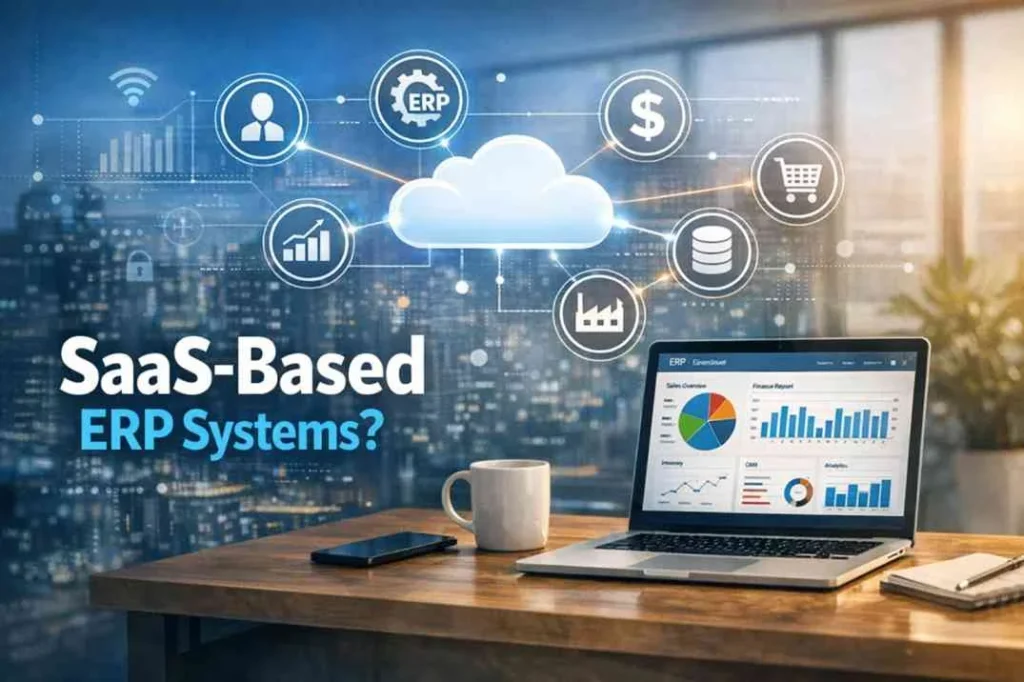
A SaaS-based ERP for schools combines this delivery model with enterprise resource planning functions: student enrollment and profiles, fee management, attendance tracking, examination and results management, staff records, parent communication, and analytics reporting — all in a single platform accessible from any device with an internet connection. The vendor handles hosting, data backups, security patches, and software updates. Your school handles operations. It’s a clean division of responsibility that removes an entire category of technical burden from school administrators.
Compare this with traditional desktop ERP or locally hosted school software: you pay upfront for a license, install the software on one or more computers, manage your own data backups, pay for IT support when something breaks, and wait for major version updates — if they come at all. For a school focused on education rather than IT infrastructure management, the operational difference between these two models is significant.
Why Are Pakistani Schools Choosing SaaS Over Traditional School Software?
The switch isn’t driven by any single factor. It’s a convergence of practical, financial, and competitive pressures that make cloud ERP Pakistan schools trust the logical next step for institutions of any size.
No Upfront Hardware Costs
Traditional school software requires you to either install the software on individual computers or set up a local server that acts as the data hub. A local server that can handle a school of 500 students reliably costs Rs. 80,000 to Rs. 200,000 or more — and that’s before you factor in UPS backup systems, networking equipment, and the IT consultant who sets it up. SaaS-based ERP systems eliminate this entirely. Your subscription covers the infrastructure. You need only a broadband connection and a browser.
Automatic Updates Without Disruption
When a traditional school software vendor releases a major update, implementing it often requires a technician visit, a scheduled downtime window, and compatibility testing. Many schools simply skip updates to avoid the disruption — and end up running outdated software for years. SaaS vendors push updates to all users simultaneously, typically overnight, with no action required from the school. New features appear in the interface, security vulnerabilities are patched, and the system evolves without any involvement from your staff.
Access From Anywhere, on Any Device
The principal can review fee collection status from home. The accountant can check outstanding balances on a tablet. The school owner can monitor attendance across three campuses from a smartphone while traveling. This remote access capability isn’t just convenient — for school groups managing multiple branches, it’s operationally essential. A cloud ERP Pakistan schools adopt makes geography irrelevant to administration.
Integrated Payment Gateways Pakistani Parents Actually Use
One of the most practical advantages of modern SaaS education system platforms built for Pakistan is native integration with JazzCash, EasyPaisa, SadaPay, and HBL. Parents pay fees directly through their mobile wallets. The system records the payment, updates the student’s ledger, and sends a WhatsApp notification — automatically. Schools using these integrations consistently report measurable improvements in fee recovery rates. One school network on OurSchoolSoftware reported a 40 percent improvement in fee recovery after activating WhatsApp-linked payment reminders through the platform.
How Do SaaS-Based ERP Systems Handle Data Security for Pakistani Schools?
Data security is the concern that surfaces most often when Pakistani school administrators consider switching to cloud-based software. It deserves a direct, honest answer.
Reputable SaaS-based ERP systems use the same security infrastructure as major financial institutions. Platforms like OurSchoolSoftware host data on Amazon AWS with 256-bit encryption — the same standard used by banks. Automatic daily backups with geographic redundancy mean your student records, fee history, and academic data are stored in multiple locations simultaneously. If one data center experiences a failure, your data remains intact and accessible.
The security reality for most Pakistani schools running desktop software is far more precarious than this. Data lives on a single hard drive or server. Backups, if they happen at all, are manual and often irregular. Power surges, hardware failures, or ransomware attacks — all common risks in Pakistani urban environments — can destroy years of institutional data in minutes. The comparison isn’t between SaaS security and perfect on-premise security. It’s between SaaS security and the actual, daily security of a school’s existing setup.
The 2024 research on cloud computing adoption in Pakistan’s education sector, conducted across institutions in Lahore, found that cloud adoption was positively associated with cost-effectiveness, flexibility, and collaboration outcomes. The one area where institutions expressed reservations — data security — reflects a perception gap rather than a factual risk differential. SaaS security, done by reputable vendors, is structurably superior to what most small and mid-sized schools can achieve independently.
What Does a SaaS School ERP Actually Cost in Pakistan?
The pricing model is one of the clearest advantages SaaS-based ERP systems offer, and it’s worth understanding in concrete terms.
Rather than a large upfront license fee — which might range from Rs. 50,000 to Rs. 300,000 or more for traditional desktop software, before hardware costs — SaaS school platforms charge a predictable recurring fee based on the number of students or campuses. Some platforms, including EduSuite, offer permanently free plans for schools with up to 50 students, with no setup fees or credit card requirement. Paid plans for schools with 200 to 500 students typically run from a few thousand to Rs. 15,000 to Rs. 30,000 per month depending on the feature tier.
When you calculate total cost of ownership over three years — license fees, server hardware, IT maintenance, annual update costs, and the staff time spent managing technical problems — SaaS consistently comes out cheaper for schools below the enterprise level. The subscription model also converts a capital expenditure into an operational one, which simplifies budgeting and removes the risk of a large upfront investment in software that might not fit.
Is Pakistan’s Internet Infrastructure Ready for SaaS School Software?
This is the practical question that deserves a realistic answer rather than either dismissal or alarm.
Pakistan’s fiber-based home broadband subscriber base grew from under 70,000 connections in 2018 to 2.6 million by early 2026 — a transformation in availability that has made reliable broadband access the norm rather than the exception in major Pakistani cities. Karachi, Lahore, Islamabad, Rawalpindi, Multan, Faisalabad, and Peshawar all have competitive broadband markets with speeds adequate for cloud school software.
For schools with occasional connectivity concerns, the answer is practical rather than theoretical: most SaaS school ERP platforms now include offline functionality for critical tasks. Teachers can mark attendance during a connectivity outage, and the system syncs automatically when the connection restores. Mobile data provides a reliable backup for accessing cloud dashboards when broadband drops. Internet reliability was a legitimate barrier five years ago. In 2025, for the vast majority of Pakistani private schools operating in urban and semi-urban areas, it isn’t.
Talk to Our Experts Today
Instant support or book a free demo
Conclusion
The shift toward SaaS-based ERP systems in Pakistani schools reflects something bigger than a software preference. It reflects a changed reality about what school administration requires. Parents expect digital communication and mobile payment options. School owners managing multiple branches need real-time visibility across campuses. Teachers need systems that work without IT support. Pakistan’s own Cloud First Policy reflects the national-level recognition that cloud technology is the direction forward.
The schools making the switch aren’t doing it because SaaS is trendy. They’re doing it because the alternative — desktop software, local servers, manual backups, and periodic technician visits — costs more, breaks more, and delivers less. If you’re evaluating school management software for your institution, compare your total cost of ownership over three years, not just the upfront price. Request demos from two or three Pakistani SaaS providers. Ask specifically about JazzCash integration, WhatsApp notification capability, and what happens to your data if you decide to switch vendors.
Related topics worth reading next: cloud vs desktop ERP for Pakistani schools, the top school ERP mistakes that cost schools money, and how to digitize school records and migrate to a school ERP system.
Frequently Asked Questions
What is a SaaS-based ERP system for schools?
A SaaS-based ERP system is school management software hosted on the vendor’s cloud servers and accessed via a browser or mobile app. You pay a monthly or annual subscription instead of a one-time license. The vendor manages updates, backups, and security — eliminating the need for local servers, IT staff, or manual maintenance on the school’s end.
Are SaaS school ERP systems safe for storing student data in Pakistan?
Yes. Reputable SaaS education system platforms use enterprise-grade encryption and host data on infrastructure like Amazon AWS — the same security standard used by major banks. Automatic daily backups with geographic redundancy mean data is protected against hardware failure, power outages, and cyberattacks in ways that most school-managed local servers cannot match.
How much does a SaaS school ERP cost in Pakistan?
Pricing varies by platform and school size. Some platforms offer permanently free plans for schools with up to 50 students. Paid plans for mid-sized schools typically range from a few thousand to Rs. 30,000 per month depending on features. Over three years, SaaS consistently costs less than traditional desktop ERP when server hardware, IT maintenance, and update fees are factored in.
Can SaaS school software work if the internet goes down?
Most modern SaaS school ERP platforms include offline functionality for core tasks like attendance marking, with automatic syncing when connectivity restores. Mobile data provides a backup access route for cloud dashboards. For urban Pakistani schools with competitive broadband options, connectivity disruptions are brief and well-handled by offline fallback features.
What is the difference between cloud ERP Pakistan schools use versus desktop school software?
Cloud ERP for Pakistani schools runs on remote servers and is accessed via browser or app, with automatic updates and no hardware requirement. Desktop software is installed on local computers, requires manual backups, and is only accessible from that location. Cloud ERP supports mobile access, multi-branch management, WhatsApp integration, and JazzCash/EasyPaisa payment gateways that desktop software cannot match natively.