
Do you ever wonder how schools operate without a dedicated management system in place? In today’s fast-paced world, where everything is becoming digital, many schools still rely on traditional methods for managing student data, communications, and day-to-day operations. But what happens when these methods fall short? Schools without a School Management System (SMS) face several challenges that can hinder their growth, efficiency, and overall functioning.
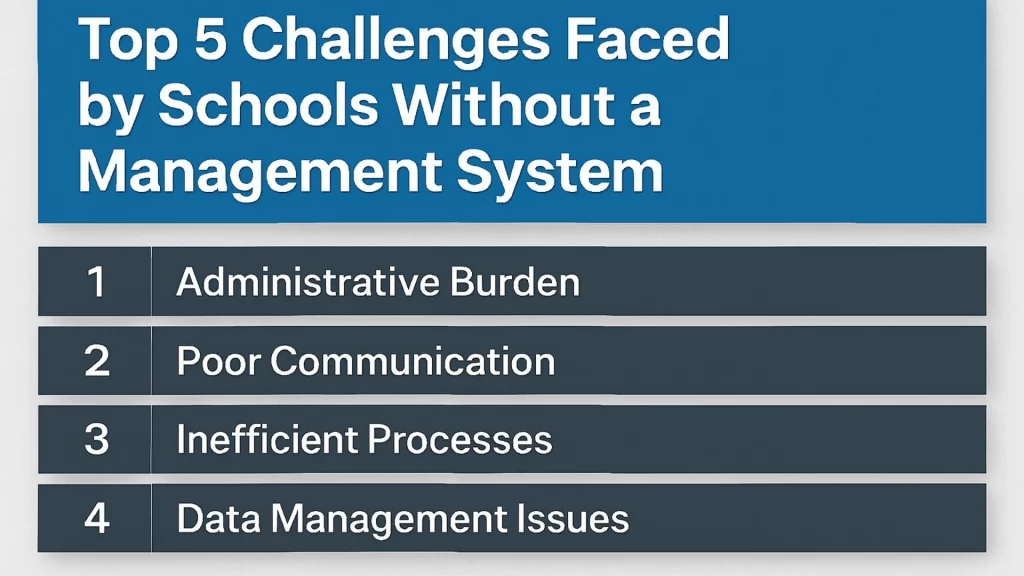
In this blog post, we will explore the top 5 challenges faced by schools that lack an integrated management system and how an admin software can revolutionize their operations.
Talk to Our Experts Today
Instant support or book a free demo
1. How Do Schools Without a Management System Struggle with Data Management?
One of the most significant challenges schools face without an automated system is the inefficiency in managing large volumes of student and administrative data. From student enrollments and grades to attendance records and teacher performance, schools generate vast amounts of data daily. Without a centralized School Management System (SMS), this data is often stored across multiple spreadsheets, paper documents, or different software platforms. This disjointed approach can lead to a variety of problems:
- Data Inaccuracy: Human errors in data entry can cause inaccuracies, leading to complications in decision-making and reporting.
- Time-Consuming: Sorting through paper documents or multiple databases to find the required data can take a lot of time and effort.
- Security Risks: Storing sensitive student information on paper or unsecured systems exposes the school to data breaches or unauthorized access.
A well-designed school management system can centralize all this data into one secure platform, ensuring that everything is easily accessible, updated in real-time, and protected by encryption.
2. How Do Administrative Tasks Become a Bottleneck Without the Right Software?
Administrative tasks in schools can be overwhelming. From managing admissions and student records to organizing reports and handling communications with parents, administrators have their hands full. When these tasks are performed manually, they not only consume a lot of time but also lead to inefficiencies and errors.
Without an admin software, schools struggle to:
- Keep Track of Payments and Fees: Managing student fees and payments manually is prone to errors. Schools may end up overlooking fees, creating confusion among parents and guardians.
- Monitor Timetables and Schedules: Without a management system, scheduling classes, exams, and extracurricular activities becomes complicated. This often results in overlaps, last-minute changes, or missed activities.
- Generate Reports: Whether it’s for annual performance reviews, academic reports, or financial statements, generating reports manually can be time-consuming and prone to mistakes.
A School Management System streamlines these administrative tasks by automating many of these processes, ensuring that administrators can focus on more strategic tasks, improve efficiency, and reduce human error.
3. How Does Lack of Communication Impact Students and Parents?
Communication is key to the success of any school environment. Without an efficient management system, communication between the school, students, and parents becomes disjointed and inconsistent. Schools often rely on paper notices, emails, or physical meetings to relay information, which can result in delays, missed messages, or confusion.
Some common communication challenges schools without a management system face include:
- Missed Updates: Without an easy-to-access platform, important updates like exam schedules, school events, or emergency notices may not reach parents or students in time.
- Limited Access for Parents: Parents may not have real-time access to their child’s performance, attendance, or behavior, making it hard to stay involved in their child’s education.
- Delayed Response Times: Administrators or teachers might not be able to respond to parent inquiries quickly if they are using traditional communication methods like phone calls or emails.
A robust School Management System (SMS) integrates features like a parent portal, messaging, and notification systems, allowing everyone in the school ecosystem to stay connected in real-time.

4. How Do Schools Without a Management System Handle Performance Monitoring?
Another significant challenge faced by schools without a management system is tracking and monitoring student performance. Teachers may struggle to keep track of individual student progress across multiple subjects, extracurricular activities, and assessments. Without an automated system, generating a comprehensive academic report can be cumbersome and time-consuming.
Key problems schools face include:
- Lack of Personalized Feedback: Teachers may not have the time or tools to give detailed feedback on every student’s performance, making it harder for students to improve.
- Inconsistent Grading: Teachers may struggle with maintaining a consistent grading system, especially when managing grades across different platforms or in handwritten records.
- Delayed Reports: Manual grading and performance monitoring can delay the process of generating report cards, leading to confusion and frustration for both parents and students.
A school management system allows teachers to record grades, monitor progress, and share personalized reports instantly. This gives students and parents the ability to track academic growth in real time and address any concerns promptly.
5. How Does the Lack of a School Management System Affect Long-Term Growth and Scalability?
As a school grows in size, the complexity of managing administrative tasks increases. Without a scalable system in place, growth can become increasingly difficult to manage. Schools without a
management system often face challenges in:
- Handling Large Enrollment Numbers: Managing a large number of students manually becomes unmanageable and inefficient.
- Expanding Programs and Services: Without proper data management, adding new programs or expanding services such as sports, after-school clubs, or online learning options becomes cumbersome.
- Maintaining Quality Standards: As schools grow, it becomes harder to ensure that the quality of education and administrative processes remain consistent without an efficient system in place.
An effective School Management System is designed to scale with the school’s growth. With centralized data, automated processes, and easy reporting, a school management system can ensure that expansion remains smooth and organized.
Conclusion
Schools without a School Management System face numerous challenges that can impact their efficiency, growth, and overall success. From the difficulties of managing data and administrative tasks to the problems of communication and performance monitoring, the absence of an admin software leaves a school vulnerable to errors, inefficiencies, and missed opportunities.
On the other hand, implementing a School Management System provides a seamless, scalable solution that can alleviate these challenges, helping schools focus on what matters most—educating and nurturing students. If you are running a school or managing educational institutions, investing in a School Management System could be the key to transforming your operations and providing a better experience for students, teachers, and parents alike.
Talk to Our Experts Today
Instant support or book a free demo
Frequently Asked Questions (FAQs)
1. What is a School Management System?
A School Management System (SMS) is a digital tool that streamlines the administrative functions of a school, including student records, attendance, communication, grading, and reporting.
2. What are the benefits of using a School Management System?
The key benefits of using an SMS include improved efficiency, centralized data management, better communication between parents and teachers, and real-time performance monitoring.
3. How does an admin software help with performance monitoring?
Admin software helps track student progress by automating grading, generating performance reports, and providing real-time updates on academic performance, which helps teachers and parents
monitor progress effectively.
4. Can a School Management System be customized for my school’s needs?
Yes, most School Management Systems offer customization options to suit the specific requirements of your school, including customizable reports, attendance systems, and parent portals.
5. Is a School Management System secure?
Yes, a reputable School Management System uses encryption and other security measures to protect sensitive student data, ensuring that information remains safe and confidential.
6. How does a School Management System improve communication?
An SMS improves communication by providing real-time notifications, messaging features, and parent portals, ensuring that both students and parents stay informed about school events, grades, and other important updates.